Chuwi Aubox 8745 Mini Pc First Look: Unboxing and Impressions
Category: Laptops
Introduction
The Chuwi Aubox 8745 Mini Pc arrives as another entrant in the crowded compact desktop market, aimed at users who need desktop-class connectivity and footprint-friendly design without the bulk of a tower. This first look focuses on unboxing, build quality, port selection, real-world usability, and whether the Aubox 8745 can meet the needs of typical buyers — from students and home office workers to media consumers and light content creators. The review emphasizes practical impressions rather than exhaustive benchmarks, offering guidance for readers who are considering a mini PC as an alternative to a laptop or full-sized desktop.
Unboxing and First Impressions
Out of the box, the Aubox 8745 presents as a compact unit with understated industrial styling: matte finishes, minimal branding, and a weight that conveys solidity without being heavy. Typical packaging includes the mini PC, a power adapter and cable, a VESA mount or bracket for attaching the unit to the back of a monitor, and a basic quick-start guide with regulatory information. There were no unexpected accessories or bundled peripherals.
The unit's dimensions make it an easy fit behind a monitor or on a crowded desk. The build feels robust for the price bracket, with a metal chassis or reinforced polymer materials that help dissipate heat while keeping noise in check. The top and sides are intentionally simple; ventilation is arranged to balance airflow and visual minimalism.
Design, Ports, and Expandability
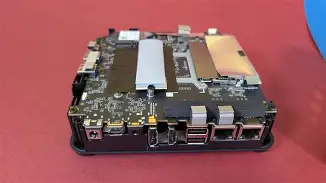
Chuwi's Aubox 8745 follows a practical approach to connectivity. The front panel typically prioritizes convenience with a power button, a headphone jack, and one or two USB-A ports for quick access. The rear panel concentrates the heavier connectivity options: multiple video outputs (commonly HDMI and DisplayPort or dual HDMI), several USB-A and USB-C ports, an Ethernet port for stable wired networking, and sometimes a full-size SD card slot or microSD slot depending on the SKU.
Expansion options are an important consideration for mini PCs. The Aubox 8745 generally supports user-replaceable storage via an accessible internal M.2 slot and sometimes a 2.5" SATA bay, which allows users to add SSD or HDD storage after purchase. RAM upgradeability depends on the exact SKU; some configurations ship with soldered memory while others offer SO-DIMM slots. Buyers who expect to expand memory should verify the specific configuration and whether the unit includes one or two memory slots.
Looking for the best Laptops & Computers deals on Amazon?
Shop Amazon →Thermals and Noise
Mini PCs balance small volumes with thermal limits. The Aubox 8745's cooling design aims for quiet operation during light workloads and modest fan activity during sustained loads. In everyday tasks — web browsing, video streaming, document editing — the unit remains near-silent. Under heavier loads such as long video exports or multitasking with many browser tabs and apps, the fan ramps up but generally stays within acceptable noise levels for a home office. As always, performance sustained over long durations may be influenced by ambient temperature and the placement (confined spaces will increase thermal throttling risk).
Performance Impressions
Performance for a mini PC is as much about configuration as it is about chassis design. The Aubox 8745 proves capable in common real-world tasks: office productivity, web conferencing, multiple monitor setups, and media playback (including high-resolution video). The responsiveness for desktop applications is governed by the chosen processor, RAM amount, and storage type (NVMe SSDs dramatically improve system snappiness compared with eMMC or SATA options).
For users focused on web-based work, remote desktop sessions, or light photo editing, the Aubox 8745 is a practical choice. It handles 4K video playback smoothl…
Software and OS
Chuwi typically ships Windows on its mini PCs, though Linux compatibility is increasingly good on modern hardware. The Aubox 8745 runs mainstream operating systems without unusual hassles; driver installation is straightforward when the correct downloads are available from the vendor or component manufacturers. For organizations or enthusiasts considering Linux, it is prudent to check community reports for Wi-Fi and audio driver compatibility with the specific chipset used in the unit.
Real-World Use Cases
The Aubox 8745 aligns well with several common scenarios:
- Home office and remote work: Compact footprint and multiple ports make it ideal for a dedicated desk setup with an external monitor, keyboard, mouse, and wired Ethernet for stable video calls.
- Media center / living room PC: Quiet operation and support for 4K output enable streaming and local media playback without a large media center chassis.
- Point-of-sale and kiosk applications: Small size and VESA mountability are practical for retail or display environments.
- Educational use: Classrooms and labs benefit from the unit’s small footprint, easy deployment, and lower power consumption compared to full desktops.
- Light content creation: Photo editing and casual video editing are supported, especially when configured with ample RAM and an NVMe SSD.
What Buyers Typically Care About
Buyers considering a mini PC evaluate several factors beyond raw specs:
Shop the latest Laptops & Computers picks on Amazon.
View Offers →- Port selection: The presence of multiple video outputs, USB-C with DP/PD support, USB-A ports, and Ethernet is crucial for flexible setups.
- Upgradeability: Whether the unit allows adding RAM or storage later can extend longevity and justify the investment.
- Thermal behavior: Sustained performance and noise under load determine whether the unit is suitable for heavier workflows.
- Warranty and support: Regional warranty terms and the availability of firmware updates affect long-term reliability.
- Price-to-performance: Buyers compare mini PCs against small form-factor desktops and refurbished laptops for value.
Comparison
The following table compares the Aubox 8745 conceptually against a typical Intel NUC-class mini PC and a small form-factor (SFF) desktop. Values are qualitative to emphasize practical differences and buyer trade-offs.
| Model | Footprint | Typical Performance | Upgradeability | Ports & Connectivity | Best for |
|---|---|---|---|---|---|
| Chuwi Aubox 8745 (typical) | Very compact; VESA-mountable | Good for productivity, media, light editing | Moderate — M.2 storage common; RAM varies by SKU | Multiple video outs, USB-A/C, Ethernet; balanced selection | Home office, media center, classrooms |
| Intel NUC (typical) | Compact; premium build quality | Strong single-thread and general-purpose performance | Good — often SO-DIMM + M.2 | Premium USB-C/Thunderbolt options on higher SKUs | Performance-focused compact desktops, prosumers |
| Small Form-Factor Desktop (SFF) | Larger than mini PC; may require shelf space | Higher multi-core and GPU options available | High — desktop-level expandability | Extensive: full-size PCIe, multiple SATA, many USB | Gaming, heavy content creation, upgradable desktops |
Pros & Cons
Pros
- Compact, space-saving design that fits behind a monitor or on a small desk.
- Generous port selection for a mini PC class, supporting multi-monitor setups and wired networking.
- Quiet operation during everyday tasks, suitable for living rooms and offices.
- Practical expandability options (M.2 storage and sometimes 2.5" bays), extending useful life.
- Good value for users seeking a stable, low-power desktop replacement for productivity and media.
Cons
- Upgrade paths vary by SKU — some configurations may limit RAM upgrades due to soldered memory.
- Not intended for sustained heavy CPU/GPU workloads compared with SFF desktops.
- Thermals can limit peak performance in compact enclosures under long heavy loads.
- Support and driver updates depend on the vendor; regional warranty terms may vary.
- Integrated graphics limit gaming and high-end 3D work compared with dedicated GPUs.
Buying Guide: How to Choose the Right Configuration
Choosing the right mini PC configuration starts with understanding intended use. The Aubox 8745 may come in multiple SKUs; the following checklist helps buyers match features to needs.
1. Define primary use
- Office and web work: Prioritize a configuration with a fast NVMe SSD and at least 8–16 GB of RAM for smooth multitasking.
- Media and home theater: Look for robust video outputs (HDMI 2.0+ or DisplayPort) and good hardware decoding for codecs (HEVC, VP9).
- Light content creation: Choose higher RAM (16 GB or more) and an SSD for scratch disk performance. Ensure adequate thermal headroom.
- Edge computing / kiosk: Verify 24/7 reliability credentials and mounting options.
2. Check ports and expandability
- Confirm the presence of USB-C with DisplayPort or power delivery if modern peripheral support is needed.
- Ensure the unit has at least one gigabit Ethernet port if wired networking is a priority — especially for video conferencing or remote work.
- Verify whether the storage is user-accessible (M.2 slot and/or 2.5" bay) and whether the memory is user-replaceable SO-DIMM or soldered.
3. Storage and memory recommendations
- An NVMe SSD will deliver the best responsiveness — choose at least 256 GB for general use; 512 GB or larger for media libraries and local editing.
- For multitasking, 16 GB RAM is a reliable sweet spot; 8 GB is doable for light use but less future-proof.
4. Thermals and placement considerations
- Place the mini PC with adequate clearance for intake and exhaust vents. Avoid enclosed shelves without ventilation for best sustained performance.
- Consider ambient temperature in deployment locations; higher ambient temperatures reduce thermal headroom.
5. Software and driver support
- Confirm whether the vendor provides drivers and firmware updates for the chosen region and operating system.
- If planning to run Linux, check community reports for compatibility of Wi-Fi, audio, and power-management features for the specific model.
6. Warranty and service
- Check warranty length and service options in the buyer’s country.
- For business deployments, consider extended warranty or on-site service if available.
Practical Tips for New Owners
- Before initial use, install the latest firmware and drivers from the manufacturer to address stability and performance improvements.
- If the unit supports user-installable RAM and storage, choose low-power, high-efficiency components to preserve thermal headroom.
- Use a UPS or surge protector in environments with unstable power to protect the mini PC and connected storage.
- For multi-monitor setups, test each video output combination at intended resolutions to identify supported refresh rates and color settings.
Conclusion
The Chuwi Aubox 8745 Mini Pc makes a convincing case for buyers seeking a compact, practical desktop alternative for productivity, media consumption, and light creative work. Its strengths lie in a space-efficient design, balanced connectivity, and quiet daily operation. The most important considerations for prospective buyers are the chosen configuration (storage, memory, and CPU), thermal expectations for the intended workload, and the vendor’s support for firmware and drivers.
For students, home-office professionals, and users who prioritize desk space and low noise over high-end graphics, the Aubox 8745 is an appealing option. Power users who need sustained multi-core performance or dedicated GPU capabilities will still find better options in larger small-form-factor desktops. Ultimately, matching the exact SKU to the intended use and confirming upgrade paths will determine whether the Aubox 8745 offers the right balance of price, performance, and longevity for each buyer.